
Tirzepatide dosage chart: compounded starting dose, mg and units, month by month
Compounded tirzepatide dosage chart: the 2.5 mg starting dose, how doses go up month by month, and how many units to draw on a U-100 syringe.
Safety
The FDA now requires a NAION warning on every GLP-1, including Ozempic, Wegovy, Mounjaro and Zepbound. The real numbers, the symptoms, and what to do.

On Nov. 9, 2026, the FDA told the makers of every approved GLP-1 drug to add a new warning to their labels. The warning concerns NAION, a rare condition that can cause sudden loss of vision in one eye. That covers Ozempic, Wegovy, Rybelsus, Mounjaro, Zepbound, Saxenda, Victoza, Trulicity and the newest pill, Foundayo. If you're on one of these medicines or thinking about starting, here's what the FDA actually said, what the numbers mean, and the one symptom you should never wait out.
Want to watch instead? The two-minute video below covers the same ground, with the numbers on screen.
The FDA issued a Drug Safety Communication requiring all GLP-1 receptor agonists to add information about a potential increased risk of NAION to the Warnings and Precautions section of their prescribing information. The change covers the entire class, not just semaglutide. That includes tirzepatide, which acts on both the GLP-1 and GIP receptors.
The agency chose its words carefully. It describes a possible risk. It did not say these drugs cause NAION, and it did not tell people to stop taking them.
| Medicine (brand) | Ingredient | How it's taken |
|---|---|---|
| Ozempic, Wegovy | Semaglutide | Weekly injection |
| Rybelsus, Wegovy pill | Semaglutide | Daily tablet |
| Mounjaro, Zepbound | Tirzepatide | Weekly injection |
| Foundayo | Orforglipron | Daily pill |
| Victoza, Saxenda | Liraglutide | Daily injection |
| Trulicity | Dulaglutide | Weekly injection |
| Xultophy, Soliqua | GLP-1 plus insulin | Daily injection |
| Exenatide (generic) | Exenatide | Injection |
NAION stands for non-arteritic anterior ischemic optic neuropathy. Put simply, the front part of the optic nerve, where it leaves the eye, doesn't get enough blood for a while. The nerve swells and some of its fibers are damaged. The result is sudden, painless loss of vision, usually in one eye. Many people first notice it when they wake up, often as a dark or blurry patch in the lower half of what they see.
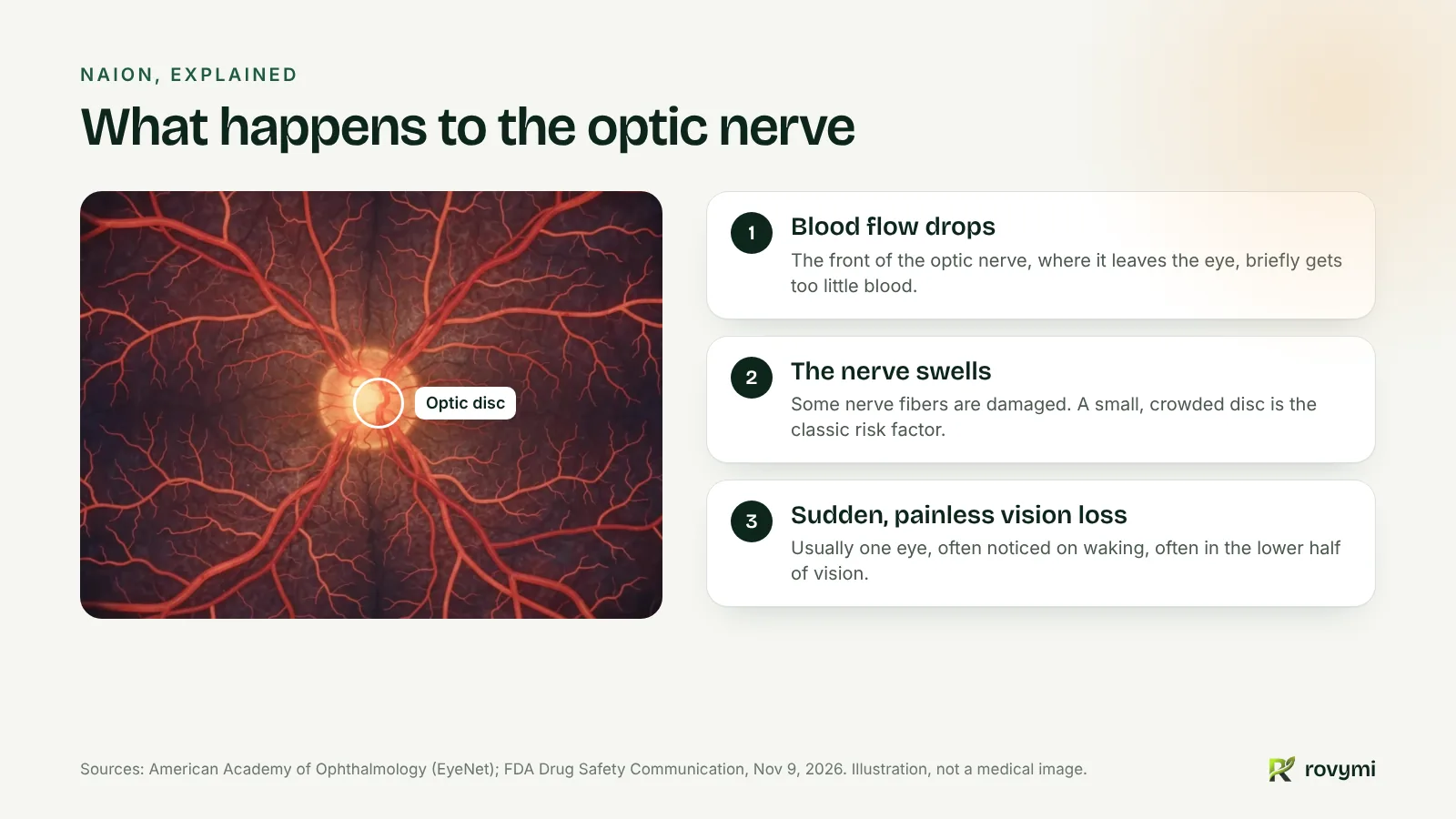
NAION isn't new, and medicine isn't its only cause. It's one of the most common optic nerve problems in adults over 50. The FDA puts the background rate at roughly 2 to 10 cases per 100,000 people over 50 each year. Eye specialists have long linked it to a small, crowded optic disc, sometimes called a "disc at risk," and to diabetes, high blood pressure, high cholesterol and smoking. Several of those are common in people who are prescribed GLP-1 medicines, which makes the question harder to untangle.
The FDA pooled data from 126 randomized clinical trials, with about 134,000 patients and nearly 289,000 patient-years of follow-up. Across all of them, there were only 15 probable NAION cases. Ten were in people taking a GLP-1 and five in people taking placebo.
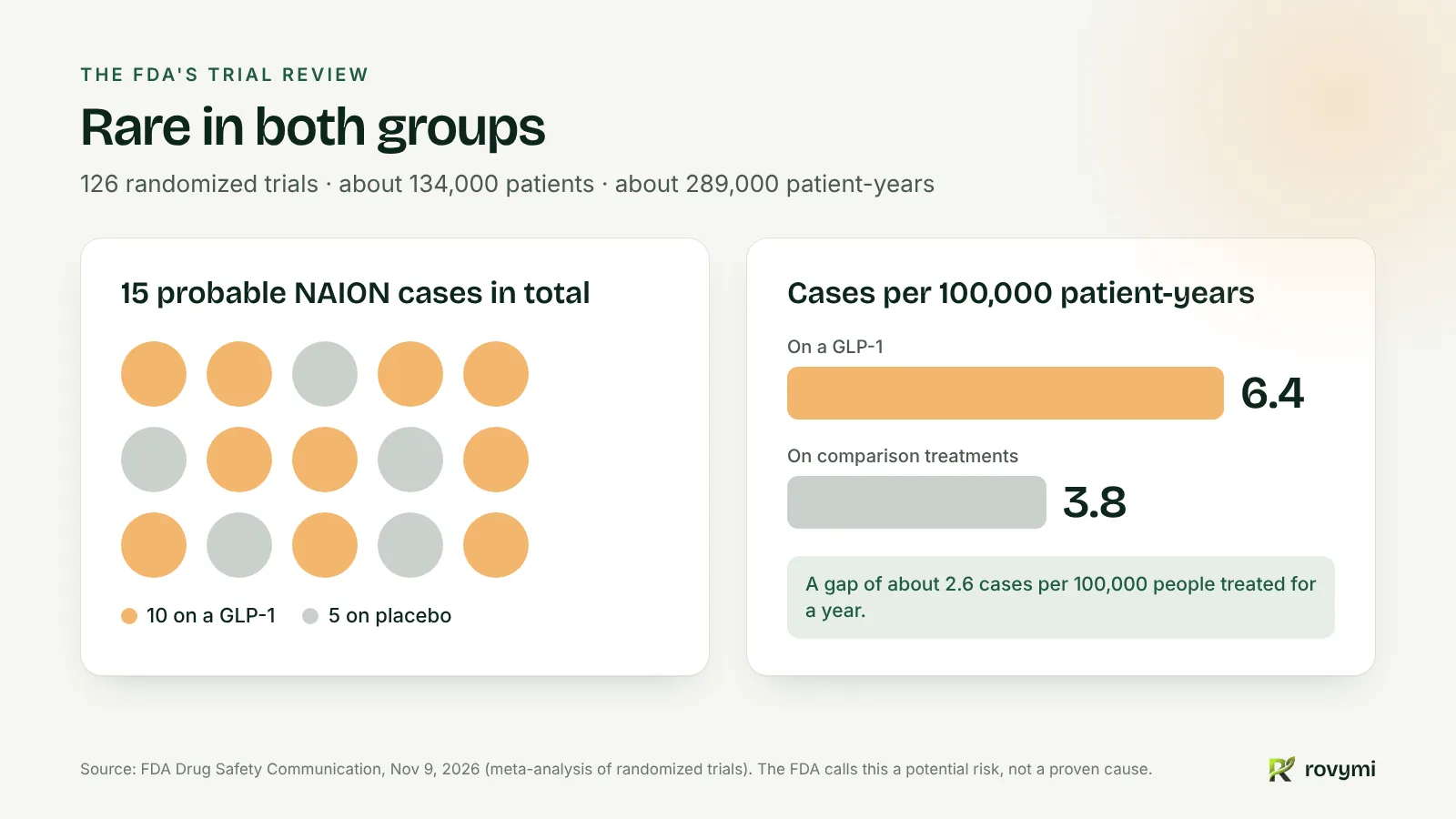
That's about 6.4 cases per 100,000 patient-years on a GLP-1, compared with 3.8 on comparison treatments. Put another way, the gap is about 2.6 extra cases for every 100,000 people treated for a year. Both numbers are small, and with only 15 events in total, the estimate isn't very precise.
The FDA also looked at real-world data from its Sentinel system in people with type 2 diabetes. The risk was higher on a GLP-1 than on DPP-4 inhibitor pills, but there was no statistically significant difference compared with SGLT-2 inhibitors. Animal studies didn't show any way these medicines would damage the optic nerve.
If you've been following this since 2024, you've probably seen a lot of different numbers. They come from different kinds of studies asking slightly different questions, and that's worth understanding before you decide how worried to be.
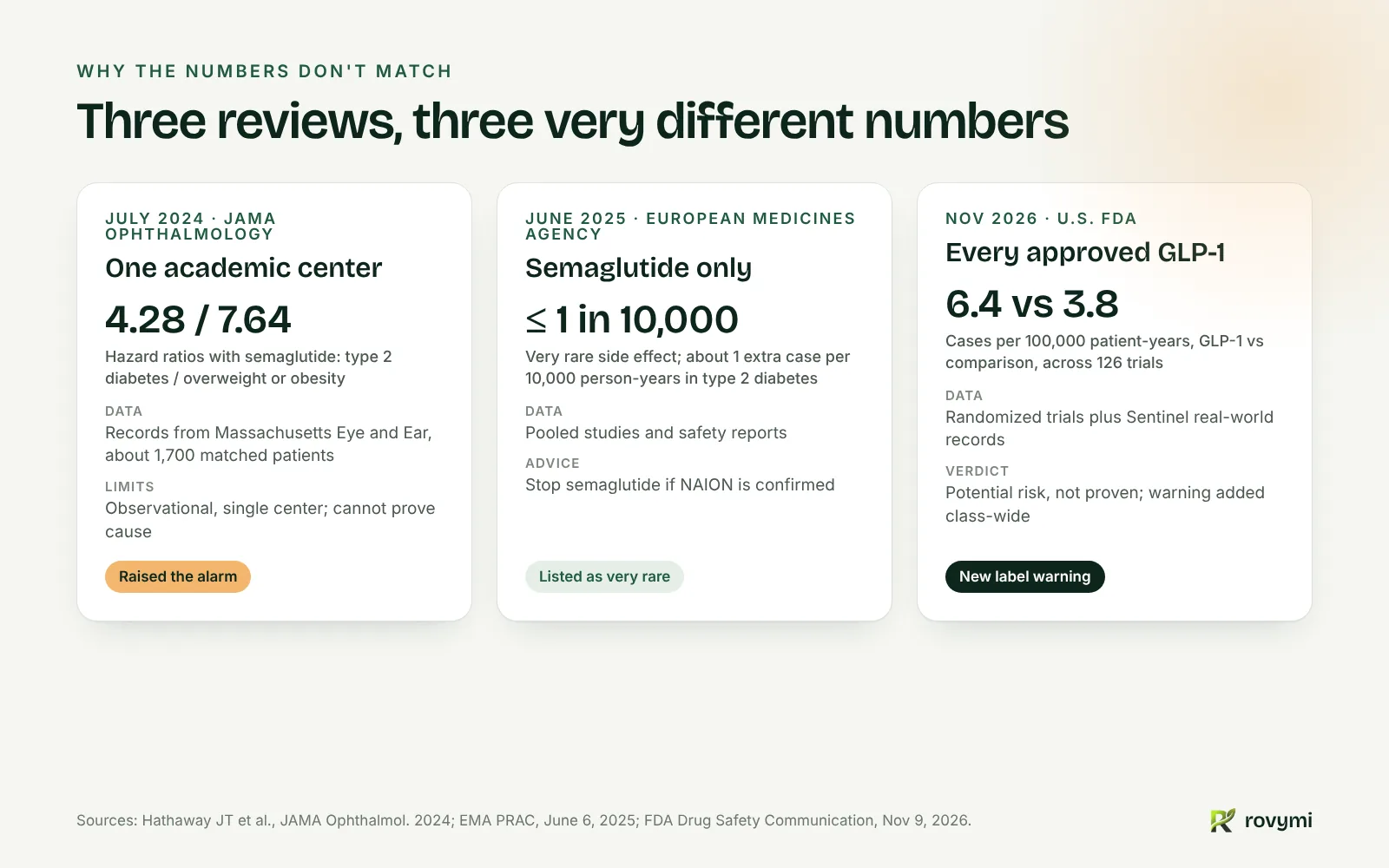
It started in July 2024 with a study in JAMA Ophthalmology from Massachusetts Eye and Ear and Harvard. It examined the records of patients seen at one academic center. Among people with type 2 diabetes, those on semaglutide had a hazard ratio of 4.28 for NAION. Among people with overweight or obesity, it was 7.64. Those numbers made the news. But the study was observational and done at a single center, and the authors themselves said it couldn't establish cause and effect.
In June 2025, the European Medicines Agency's safety committee reviewed the evidence for semaglutide and concluded that NAION is a very rare side effect, meaning it may affect up to 1 in 10,000 people. It estimated about one additional case for every 10,000 person-years of semaglutide treatment in people with type 2 diabetes.
The FDA's November 2026 review is the broadest of the three. It covers every approved GLP-1, including tirzepatide and orforglipron, and leans on randomized trial data. It found a small difference, called the risk potential rather than proven, and added the warning to the whole class.
So the big hazard ratios came from one center's records, while the regulators who pooled far more data found a much lower risk. All three agree on what matters most to you: the risk shows up in the data, it's rare, and sudden vision loss needs fast attention.
The short answer is no, not in the way many headlines imply. The FDA has not said that Ozempic or any other GLP-1 causes blindness. It has said there may be a small increase in the risk of NAION, which can cause permanent loss of part of the field of vision in one eye. NAION rarely causes total blindness, but the damage is real and often lasting, which is why the warning matters.
The same applies to tirzepatide (Mounjaro and Zepbound). Most of the early research focused on semaglutide, but the FDA applied the warning to the whole class, so the advice below is the same whichever GLP-1 you take.
Here's the hard part. According to the American Academy of Ophthalmology, there's no medical or surgical treatment proven to improve vision after NAION. About 70% of people stay about the same, about 20% get modestly better, and about 10% get worse over the first few weeks before things settle. Complete recovery is unusual. About 15% of people develop NAION in the other eye within five years.
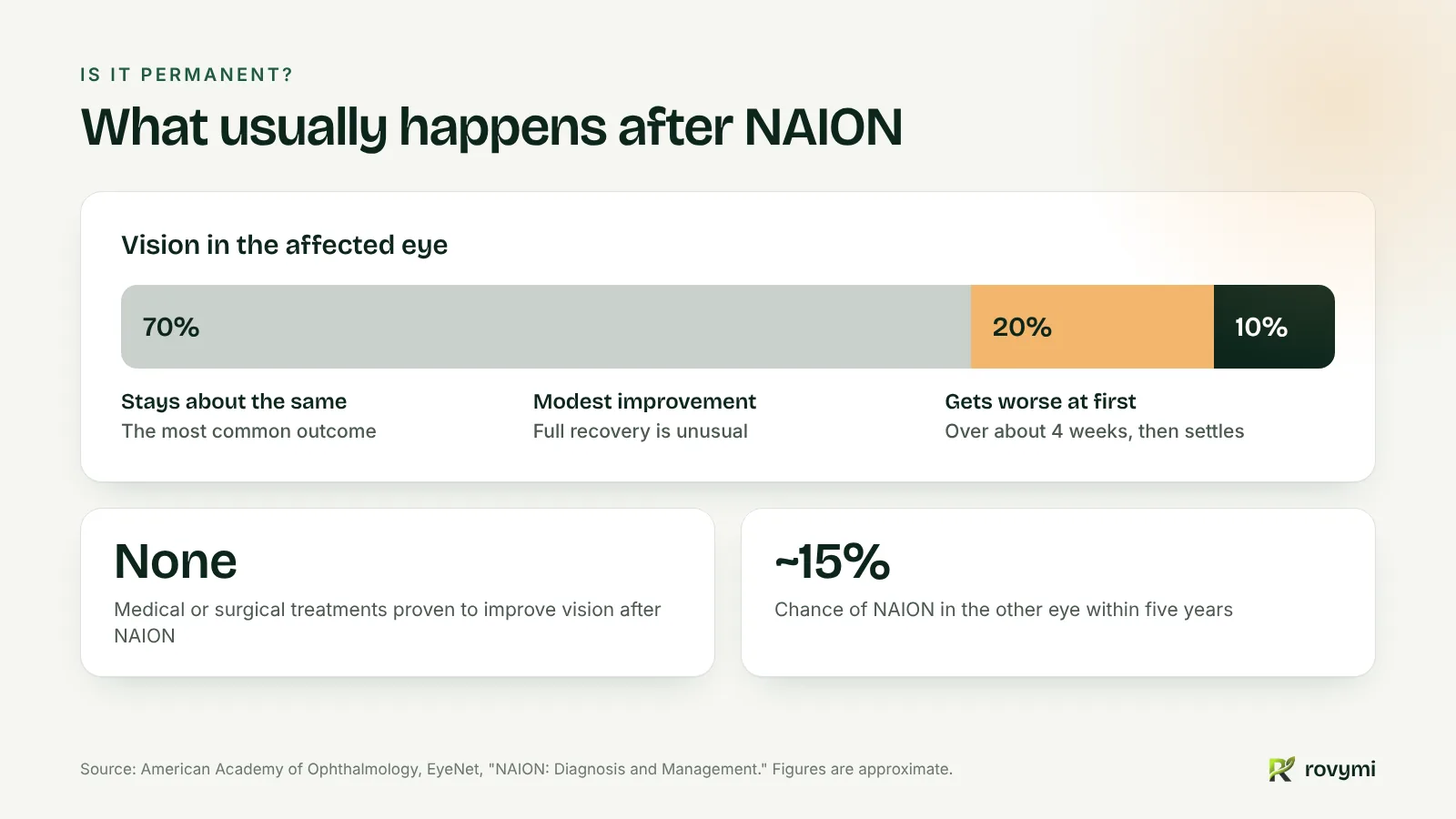
That's why the advice is about speed and prevention. A quick eye exam can rule out other causes of sudden vision loss, some of which are emergencies that can be treated. It also lets you and your prescriber decide together whether to stop the medicine. The European regulator advises stopping semaglutide if NAION is confirmed. The FDA tells prescribers to consider stopping a GLP-1 in anyone who develops NAION, unless the benefits clearly outweigh the risk.
Get medical care the same day if you notice any of these, especially in one eye:
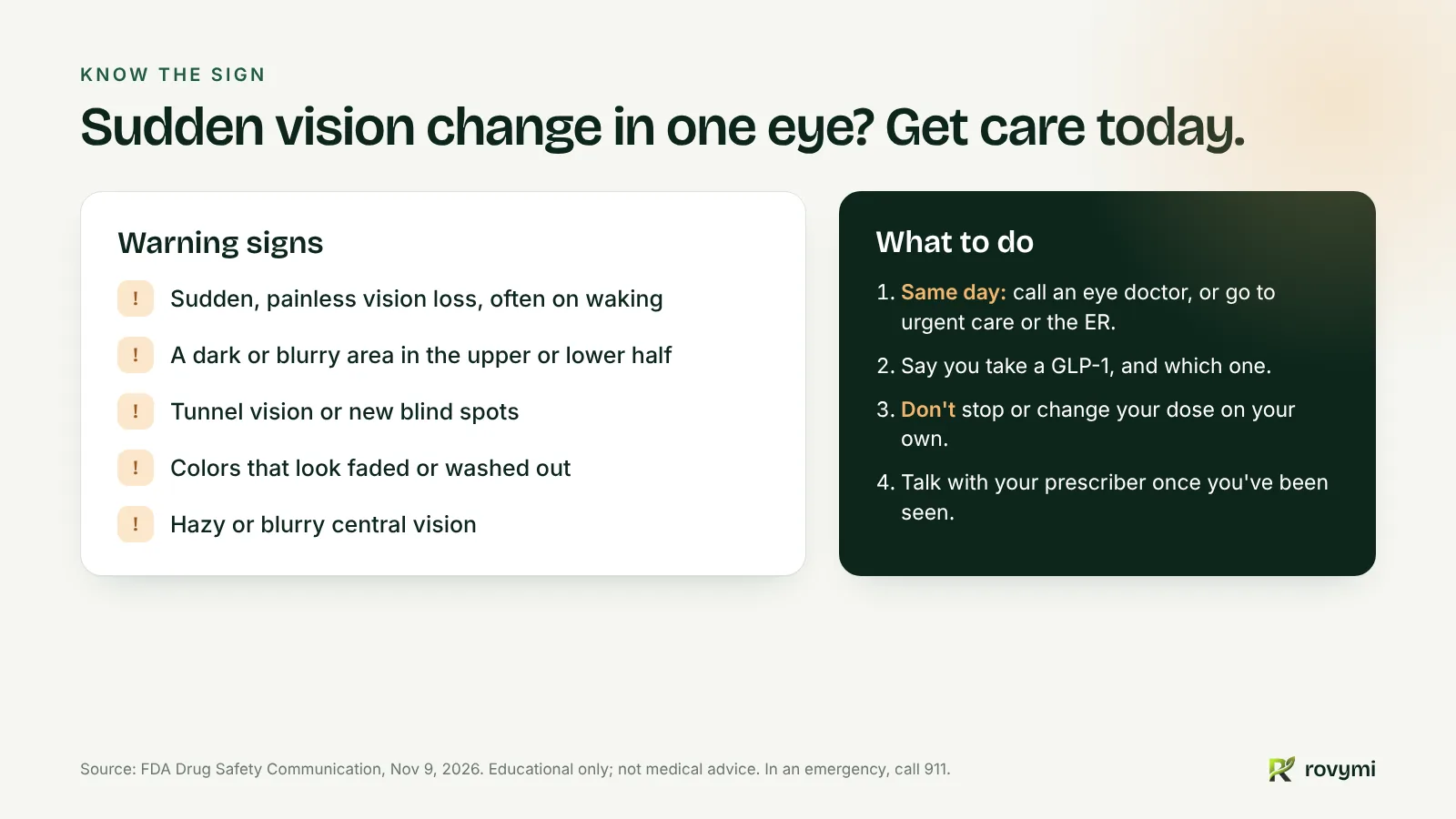
Call your eye doctor or go to urgent care or an emergency room, and tell them you take a GLP-1 medicine and which one. Don't stop or change your dose on your own. Once you've been seen, talk with whoever prescribes it.
Tell your prescriber before you start a GLP-1 if you've ever had NAION or any sudden vision loss, if an eye doctor has told you that you have a small or crowded optic disc, or if you have diabetic eye disease. People who've had NAION are more likely to get it again. Your prescriber might suggest an eye exam first, a different medicine, or just closer follow-up.
The FDA's label change applies to the FDA-approved brand-name drugs. Compounded versions of semaglutide and tirzepatide are not FDA-approved, and they weren't part of the clinical trials the FDA reviewed. There's no reason to assume they carry less risk. If you take a compounded GLP-1, the same symptoms and the same advice apply. Rovymi has added NAION to its Important Safety Information.
The new warning is real, the risk is small, and the cause isn't proven. Out of more than 134,000 trial patients, the FDA counted 15 probable cases, and the gap between GLP-1 users and everyone else was a few cases per 100,000 people each year. That's not a reason to panic or to quit a medicine that's helping you. It is a reason to know one symptom by heart: sudden, painless vision loss in one eye means getting care that same day.
For the rest of the picture, see our guides to common GLP-1 side effects and what compounded GLP-1s are and aren't.
Rovymi offers compounded semaglutide online and compounded tirzepatide online, by prescription only and only if a U.S.-licensed clinician decides it is right for you. See prices and what is billed up front.
The FDA has not said that Ozempic or any GLP-1 causes blindness. On November 9, 2026, it required all GLP-1 labels to warn of a possible increased risk of NAION, a rare optic nerve condition that can cause sudden, often permanent, partial vision loss in one eye. NAION rarely causes total blindness.
Rare. In the FDA's review of 126 trials with about 134,000 patients, there were 15 probable cases: about 6.4 per 100,000 patient-years on a GLP-1 versus 3.8 on comparison treatments. Europe's regulator classifies NAION with semaglutide as very rare, up to 1 in 10,000 people.
Often, yes. The American Academy of Ophthalmology says there is no proven treatment to restore vision. About 70% of people stay the same, about 20% improve modestly and about 10% worsen at first. That's why sudden vision loss in one eye needs same-day care.
Not on your own. The FDA did not tell patients to stop. Talk with your prescriber, especially if you've had NAION or sudden vision loss before. If NAION is confirmed, your prescriber will usually recommend stopping the medicine.
Yes. The FDA applied the warning to the whole GLP-1 class, including tirzepatide (Mounjaro and Zepbound), even though most earlier research focused on semaglutide.
The label change covers FDA-approved medicines. Compounded GLP-1s are not FDA-approved and were not studied in those trials, so there's no reason to assume they're safer. The same symptoms and the same advice apply.
This article is for general information and isn’t medical advice. See our Important Safety Information.

Compounded tirzepatide dosage chart: the 2.5 mg starting dose, how doses go up month by month, and how many units to draw on a U-100 syringe.
Constipation is one of the most common GLP-1 side effects. Why it happens, simple daily fixes, when to ask about a laxative, and the warning signs to act on.

How telehealth weight loss programs work, what they cost, and how to check the clinician, pharmacy, medication, follow-up care and fine print before you join.
Answer a few questions online. A licensed clinician reviews them and, if it's right for you, your treatment ships to your door.
See if you qualifyRovy
Rovymi concierge · automated
Hi, I'm Rovy. I can explain our treatments and prices, or build a plan with you in three taps.
Automated guide with general information, not medical advice. Don’t share health details here. Emergency: call 911.